
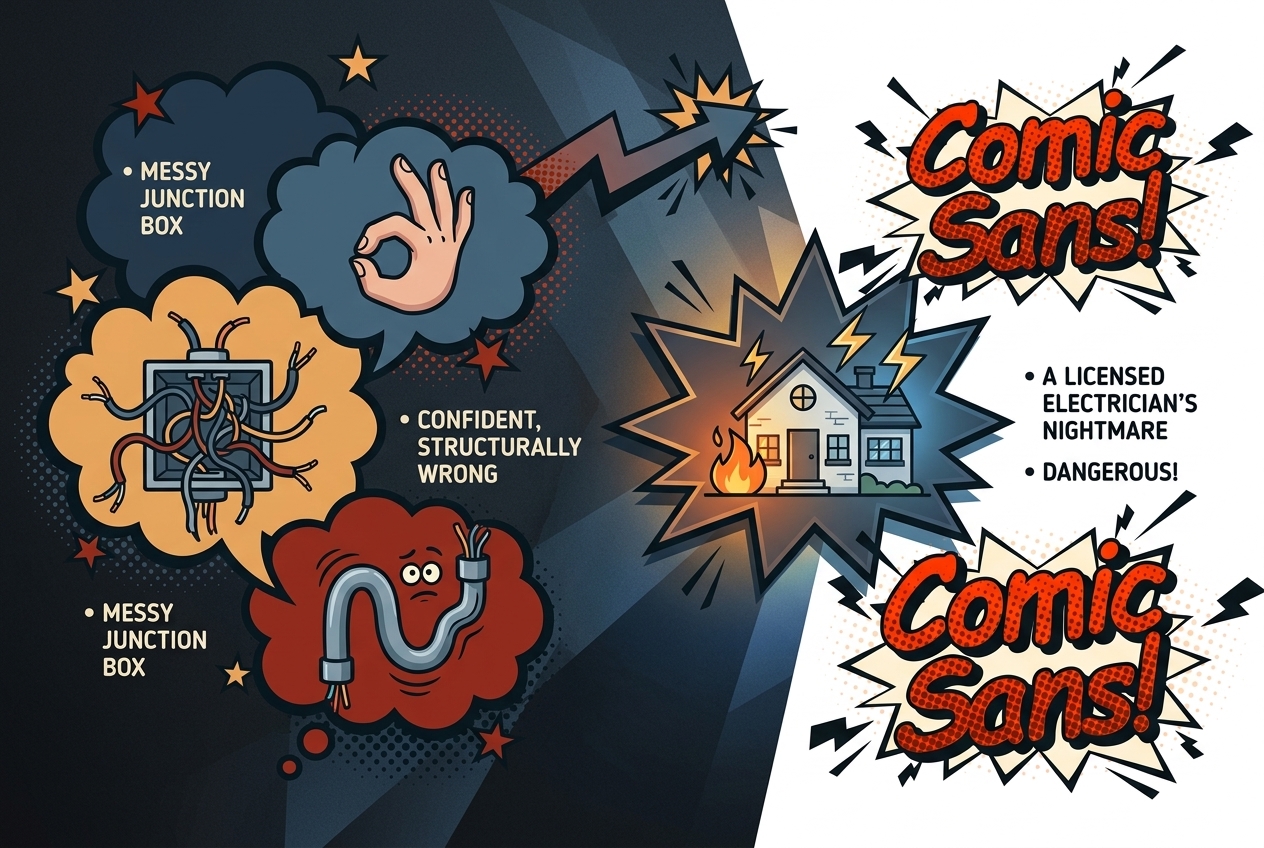
You know the feeling. You glance at a sign, and something in your soul recoils — the kerning is a crime scene, the letters slouch, and someone clearly opened a font menu, saw Comic Sans, and thought it conveyed exactly the right gravitas. It’s wrong in a way you feel before you can explain it.
Open the average junction box in a “renovated by the previous owner” house and a licensed electrician gets that exact same feeling. Cheerful, confident, and structurally wrong. The difference is that bad typography just offends people, while bad wiring can burn the building down. So let’s use the comparison for something useful: here are the most common amateur electrical “fonts” hiding in homes, why each one is genuinely dangerous, and what you can actually do about them.
Crime #1: The mismatched, half-twisted connection
The wiring equivalent of pairing a serif headline with Comic Sans body text is the bad splice — wires joined loosely, twisted by hand without a proper connector, or capped with the wrong-size wire nut.
Why it matters: loose connections are one of the leading causes of house fires, because electricity meeting resistance produces heat. A connection that’s 95% tight isn’t “mostly fine” — it’s a spot that warms up every time current flows, slowly cooking the surrounding insulation until it fails. The U.S. Consumer Product Safety Commission notes that faulty wiring and connections are a major contributor to the thousands of residential electrical fires reported each year, many of them entirely preventable. You can read its home electrical safety guidance at CPSC.gov.
What you’ll notice: outlets or switch plates that feel warm, faint scorch marks or discoloration, or a buzzing sound from a fixture. Those are not quirks. They’re a misspelled word your house is showing you.
Crime #2: The overloaded circuit
Cramming forty-two words onto a business card and shrinking the type to fit is exactly what people do to a circuit when they keep adding loads to it — a space heater here, a window AC there, a power strip feeding another power strip. Everything is technically present. Nothing has room to breathe. Eventually it overheats, and this time the metaphor is literal.
Why it matters: every circuit is rated for a specific load, and the breaker is there to cut power before the wire overheats. A breaker that trips repeatedly isn’t being annoying — it’s doing its job and telling you the circuit is carrying more than it should. The fix is never to swap in a bigger breaker so it stops tripping; that just removes the smoke alarm and leaves the fire.
What you can actually do: unplug high-draw appliances onto separate circuits, stop using power strips and extension cords as permanent wiring, and if a circuit trips again and again, treat it as a sign you need more capacity — not more tolerance. The Electrical Safety Foundation International publishes excellent plain-language guidance on circuit overloads and how to spot them.
Crime #3: Treating the color code as a suggestion
Black, white, red, green, the occasional optimistic blue — to a DIYer they can look like decorative choices. They are not. Wire colors are a safety standard, and ignoring them is how you end up with a “hot” wire where a neutral should be, or a grounding conductor that grounds nothing.
Why it matters: the color code, along with rules for grounding and for modern protective devices like GFCIs (in wet areas) and AFCIs (which detect dangerous arcing), exists to make a system that’s safe for the next person who opens that box — possibly years later, possibly you. These requirements come straight from the National Electrical Code, published and maintained by the National Fire Protection Association, and they’re the difference between a system that’s merely legible and one that’s actually correct.
The trap in all three of these is the same phrase: “but it still works.” Comic Sans is legible too. Legibility is the floor, not the ceiling — and “it technically works” is precisely how a hidden fault survives long enough to become a real problem.
Hire the Helvetica of electricians
Here’s the genuinely useful takeaway: a clean, code-compliant electrical system is like good typography in that you’re never supposed to notice it. It just works, quietly and correctly, every day, while you get on with your life and never think about wire gauge.
That invisibility is the mark of someone who respects the rules — licensed, inspected, and working to code — rather than improvising with confidence. If your home is showing you any of the warning signs above, or you’ve inherited wiring of mysterious origin, the right move is to have a professional evaluate it rather than live with it. The team at Primetime Electrical handles exactly that kind of work: tracing faults, correcting overloaded and improperly wired circuits, and making the unglamorous fixes you’ll never have to think about again. And to be clear, none of this is a DIY project — the inside of a panel stays in trained hands, the same way you wouldn’t let a stranger redesign your logo at 11pm with a free font.